
What is wabi-sabi and how to apply it with handmade stoneware ceramics
There is a crack in the glaze. A variation in tone that happened in the firing and wasn't planned. A surface that is neither perfectly smooth nor perfectly rough.
For the industrial aesthetic, that is a defect. For wabi-sabi, it is exactly the point.
What is wabi-sabi
Wabi-sabi is a Japanese aesthetic philosophy that finds its beauty in the impermanent, the imperfect and the incomplete. It is not a design movement in the Western sense of the term. It is, rather, a way of looking.
Wabi refers to austere simplicity, to finding richness in the elemental. Sabi speaks of the beauty that the passage of time brings, of the marks left by use, of patina as value and not as deterioration.
Together, they describe something that contemporary minimalist decor is rediscovering: that industrial perfection is cold, and that what truly moves us always has something unpredictable about it.
Why handmade stoneware ceramics is the most authentic expression of wabi-sabi
Not all materials are compatible with this philosophy. Plastic has no history. Industrial glass doesn't accumulate time. Perfect marble speaks of control, not process.
The handmade stoneware ceramics is different. And it is so for concrete reasons.
When a piece goes into the kiln at 1200°C (2192°F), the ceramicist has already done their part. From that moment on, the heat, the glazes, the kiln atmosphere and time decide the final result. No one completely controls what comes out. There are variations in tone from one piece to the next. There are textures that appear where they weren't planned. There are results that exceed what the hand imagined.
That is, in the most precise sense, wabi-sabi applied to studio ceramics.
Every stoneware vase has a surface that will not repeat. Every sculpture carries the marks of the process: the brush stroke in the glaze, the tension of the stoneware as it cools, the exact color determined by that firing and no other. They are not imperfections. They are proof that something real happened there.
How to apply wabi-sabi in home decor
Adopting this philosophy doesn't require redesigning the space. It requires changing the criterion with which you choose the objects that enter it.
Choose materials with a visible process
The Handmade ceramics shows its process on the surface. A glaze applied with a brush has a direction. Stoneware has weight and density. None of this can be faked in industrial production, however hard they try.
In a minimalist decor based on wabi-sabi, that visible process is the ornament. You don't need to add anything else.
Favor the singular over the repeatable
A A unique design object —a piece of studio ceramics, a stoneware sculpture— fulfills a role in the wabi-sabi aesthetic that no mass-produced object can. Not because it is more expensive, but because it is unrepeatable. It has an existence of its own.
Placed in a corner of the living room, in the foyer or on a clear coffee table, that object competes with nothing. It is the focal point without needing to be.
Work with restrained palettes
Wabi-sabi doesn't use color to decorate. It uses the absence of color to reveal. Grays, matte blacks, off-whites, ochres and earth tones are the shades that let texture speak.
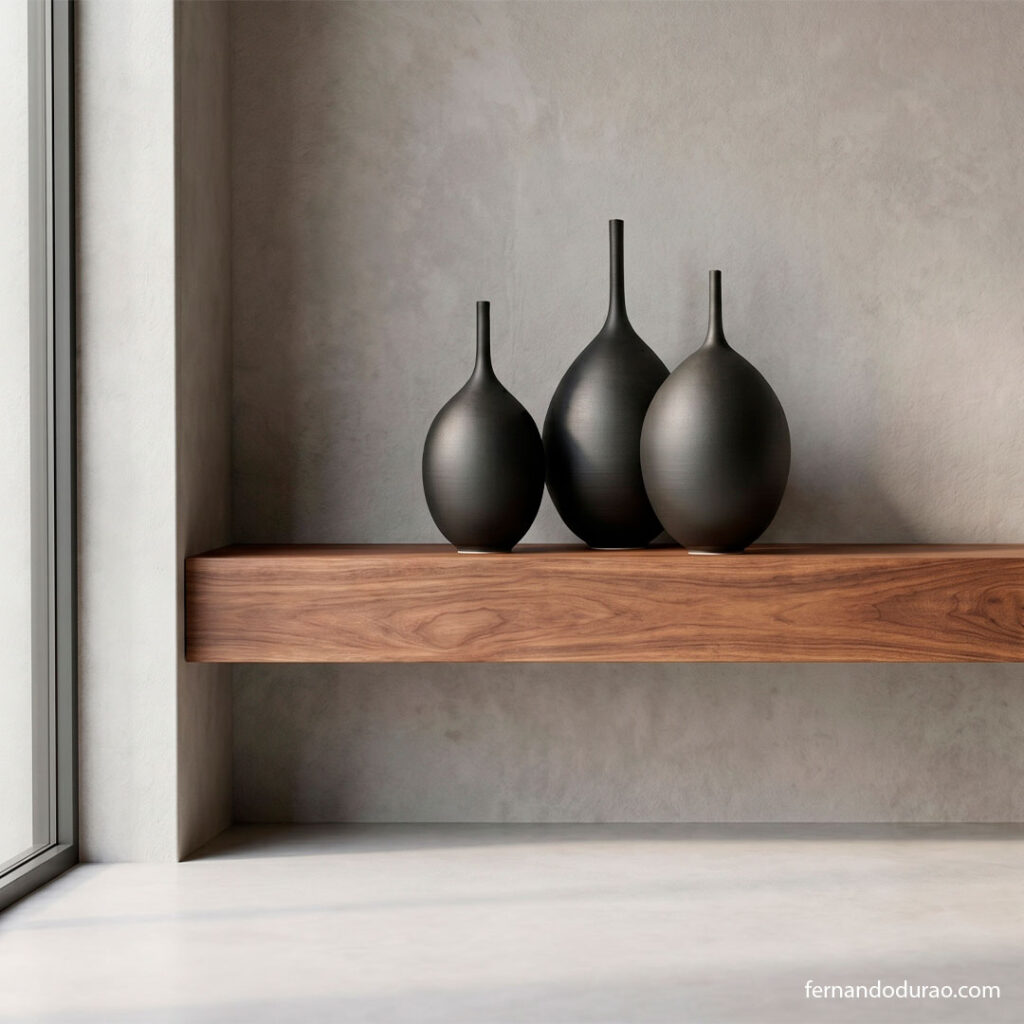
The decorative vases in stoneware with a matte black glaze or with quartz finishes fit naturally into this palette. They need no context to work. They work alone, with a plant beside them or with nothing.
Accept time as part of the design
Wabi-sabi understands that objects change. That time leaves marks. That this isn't deterioration but an accumulation of history.
A piece of handmade stoneware ceramics ages well. It doesn't fade. It doesn't warp. The patina it develops over the years makes it more interesting, not less. It is the exact opposite of the disposable.
Wabi-sabi and luxury: a relationship that seems contradictory but isn't
There is a frequent confusion: associating wabi-sabi with the rustic, the cheap, the “homemade”. It is exactly the opposite.
Wabi-sabi aesthetics in their purest form require extremely high judgment. Knowing which imperfection is worth keeping and which is simply a mistake. Telling the texture that contributes from the one that distracts. Choosing the design object that has real density and not the one that imitates the handmade from mass production.
That is, ultimately, what a ceramicist with 35 years of craft does. Not manufacture objects. Develop judgment.
The Black, Quartz and Moradores collections in a wabi-sabi key
Each of Fernando Durao's collections converses with this philosophy from a different place.
Black works with black from its many dimensions: the absolute matte, the satin that changes with the light, the glossy that reflects the space. Three finishes, a single depth.
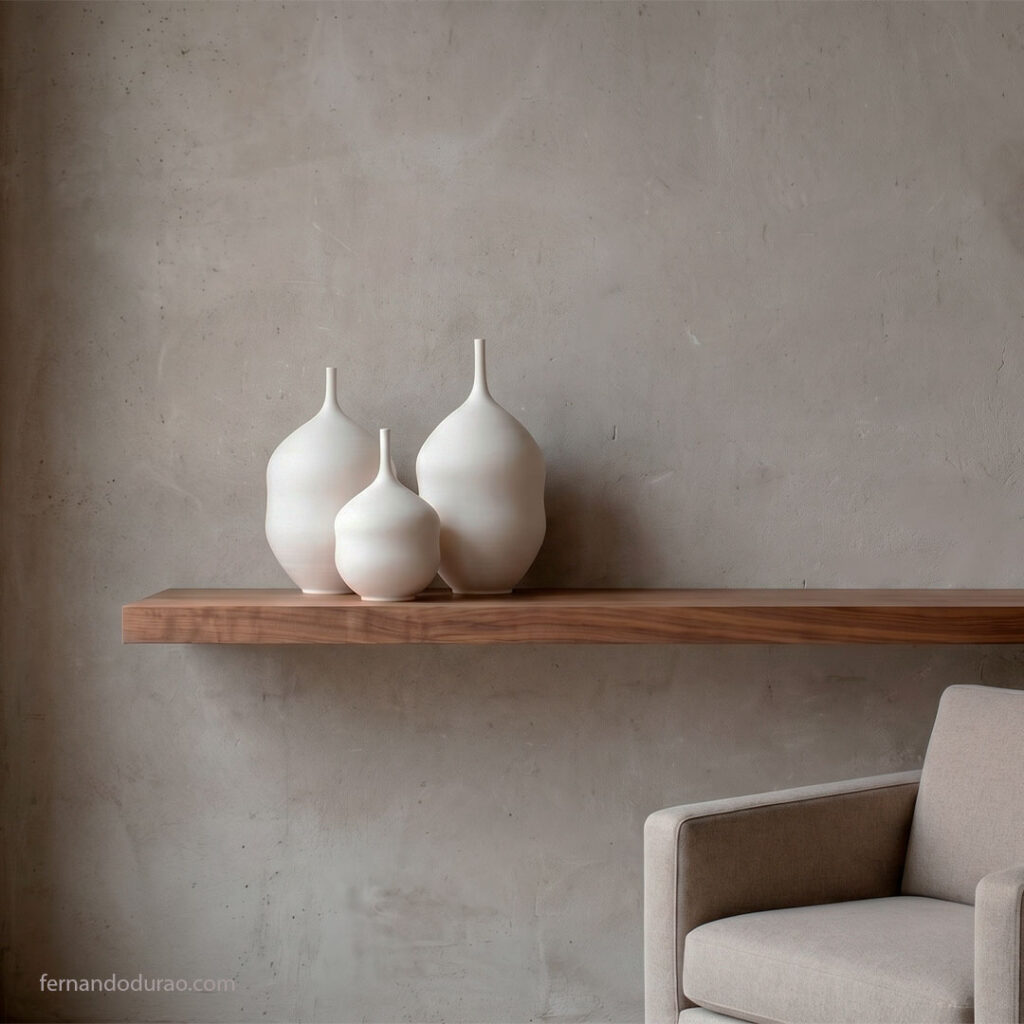
Quartz takes the texture of quartz as its starting point. The surface of these pieces has the irregularity of the mineral, translated into the language of stoneware. Each piece has a relief of its own.
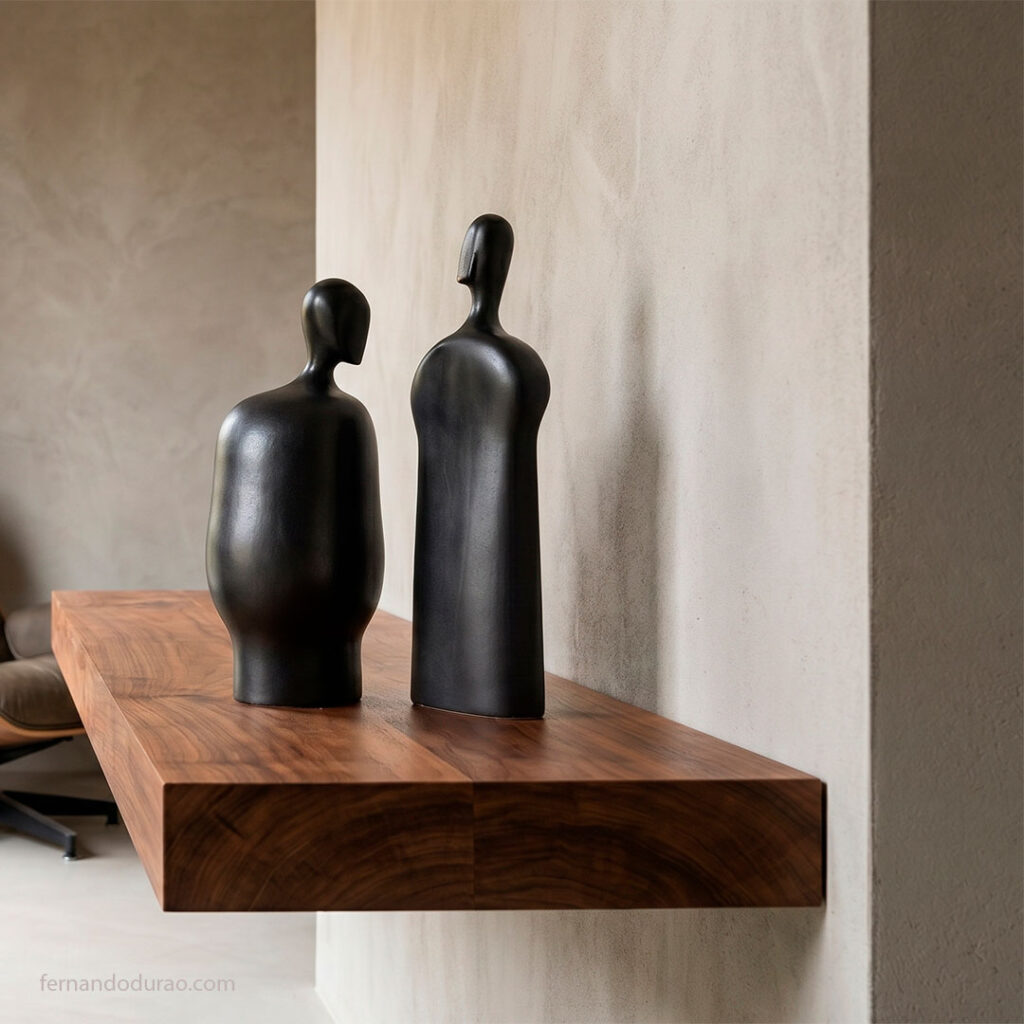
Moradores is the collection closest to the sculptural. Pieces that are not vases in the conventional sense, but presences. Objects that dwell in the space — hence the name — without needing explanation.
All the pieces are one of a kind and signed. Shipping throughout the country.
Frequently asked questions about wabi-sabi and handmade ceramics
Is wabi-sabi the same as minimalism? Not exactly. Minimalism reduces in order to simplify. Wabi-sabi accepts imperfection and the passage of time as values in themselves. They are compatible — and often combined in contemporary decor — but they start from different points.
Which materials are most wabi-sabi? Those that show their process: handmade stoneware ceramics, untreated wood, natural linen, stone. Materials that have variation, texture and that change over time.
How do I know whether a ceramic piece is really handmade? By the weight, the surface variation and the presence of small irregularities that are typical of the handmade process. An industrial piece is identical to the next one. A piece of studio ceramics never is.
Can I combine handmade ceramics with modern decor? Yes, and it is exactly the most interesting combination. A matte black stoneware piece in a room of modern lines creates a tension that enriches both elements. They don't compete: they enhance each other.
Fernando Durao. Handmade ceramicist. 35 years of craft. Workshop in Lanús, Buenos Aires. Free shipping throughout Argentina.