
How to light studio ceramics: a guide for architects and decorators
Lighting studio ceramics is a technical and aesthetic decision at the same time. A stoneware piece with a complex glaze can go unnoticed under generic overhead light, or become the element that defines the whole atmosphere of a room if the light works it well.
This guide is meant for architects, interior designers and decorators who work with one-of-a-kind pieces and want to get the most out of them within the project.
Why lighting completely changes a piece of handmade ceramics
Not all surfaces react the same to light. An industrial piece, with a uniform finish and no variation in texture, looks the same under any lighting. A piece of handmade stoneware ceramics is the opposite.
Stoneware has relief. It has glaze variations that happened in the firing and don't repeat. It has matte areas that absorb light and satin or glossy areas that return it. That surface complexity is only activated when the light comes from the right angle.
The difference between a well-lit piece and a poorly lit one is not subtle. It is the difference between a design object that speaks and one that stays silent.
The three types of lighting for studio ceramics
1. Raking light: the one that reveals the texture
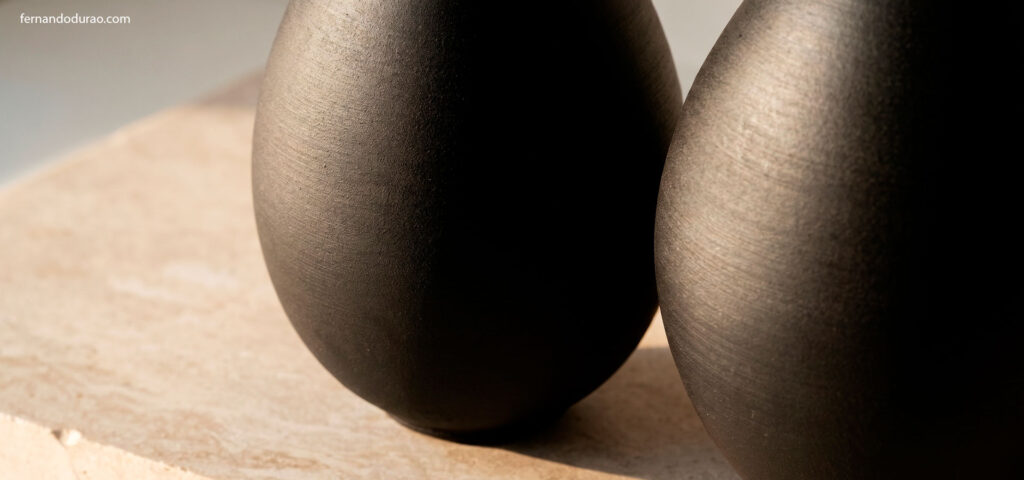
Raking light is the most effective for pieces of handmade stoneware ceramics with a worked surface. It comes from a low, lateral angle, almost parallel to the surface of the piece.
What does it do? It creates shadows in the minimal reliefs of the glaze that can't be perceived at a glance. Those micro-variations of texture — the brush mark, the glaze bubbles, the natural irregularities of stoneware — become visible and three-dimensional.
How to apply it: A spot or wall light placed between 20° and 30° from the vertical of the piece. Ideal for vases with pronounced texture, like those of the Quartz collection.
2. Focal light from above: the one that defines the form
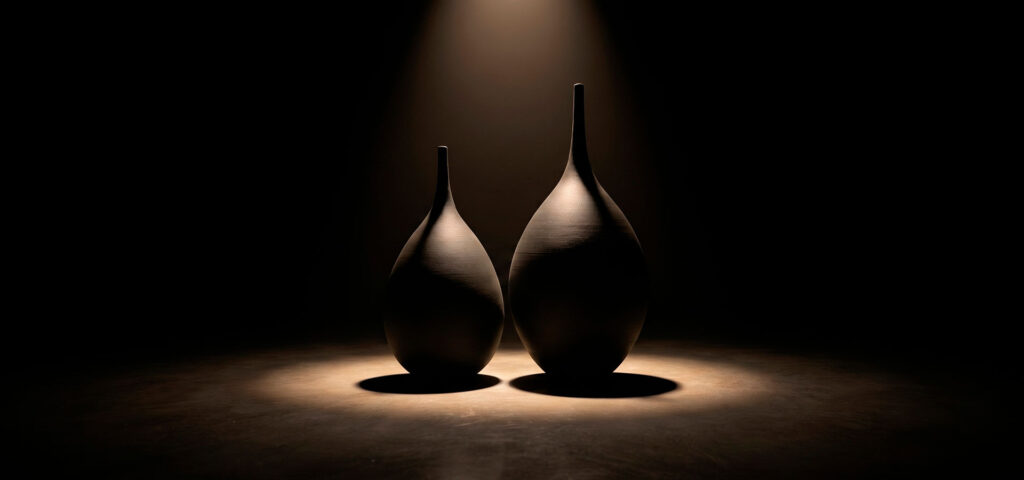
A well-calibrated overhead spot — not the typical ceiling downlight, but an adjustable one with controlled aperture — casts the shadow of the piece downward and creates a halo of light that visually isolates it from its surroundings.
It is the most effective lighting for decorative vases with pure lines and a clear silhouette. It highlights the form without distracting with texture.
How to apply it: An adjustable track spot, with a beam angle of between 15° and 25°. Positioned directly above the piece, at a distance that lets the cone of light cover the object without spilling over too much.
3. Lateral accent light: the one that works the glaze
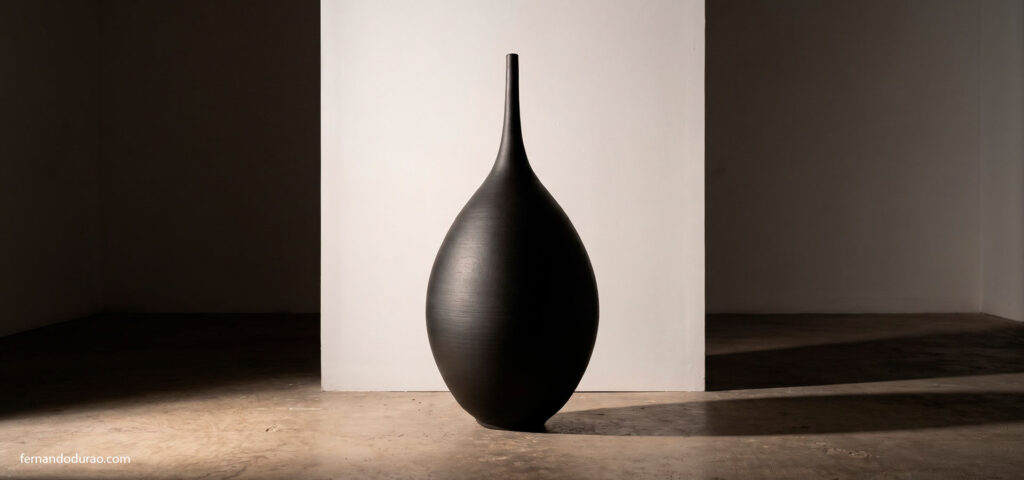
For pieces with complex glazes — black with glints, quartz with variations in tone, glazes that combine matte and glossy on a single surface — lateral accent light is the one that draws the most information out of the piece.
It comes from the side at mid-height and travels across the surface diagonally. It activates reflections in the satin or glossy areas and leaves the matte areas in shadow, creating a visual tension that makes the piece change its look depending on where you view it from.
How to apply it: A wall light or lateral track spot, at the mid-height of the piece. It works especially well with the Blackcollection, where the differences between matte, satin and glossy are the central argument of each vase.
Color temperature: the detail most often overlooked
A matte black stoneware piece under cool light (5000K or more) loses depth. It flattens. The black turns gray.
The same piece under warm light (2700K–3000K) comes alive. The black gains density. The glaze starts to show layers.
General rule for studio ceramics: always warm light, between 2700K and 3000K. It is the temperature that works best with the natural glazes of stoneware and the one closest to the light the ceramicist used to assess the piece when taking it out of the kiln.
For the modern vases with white or quartz glazes, 3000K is the ideal balance point: warm enough to bring the surface to life without yellowing the light tones.
Frequent mistakes when lighting studio ceramic pieces
Generic overhead light with no direction. The standard downlight flattens any texture. If the project has pieces of value, they deserve lighting of their own.
Too much light. A handmade ceramic piece doesn't need to be the most brightly lit in the room. It needs to be the best lit. The difference is subtle but decisive.
Cool light on dark glazes. We've already mentioned it, but it bears repeating: cool light kills the depth of black stoneware. Always 2700K–3000K.
Ignoring the context. The lighting of a piece interacts with that of the rest of the room. A well-lit design object in a space with overly intense general light loses prominence. Contrast is what creates the visual focus.
Lighting by type of piece and collection
| Piece / Collection | Recommended type of light | Temperature |
|---|---|---|
| Black vases (matte black) | Lateral raking light | 2700K |
| Black vases (satin/glossy) | Lateral accent light | 2700K–3000K |
| Quartz collection | Raking + overhead focal | 3000K |
| Moradores collection (sculptural) | Overhead focal + raking | 2700K |
| Tall floor vases | Uplighter from below or track spot | 2700K–3000K |
Pieces made for spaces with discernment
The Black, Quartz y Moradores by Fernando Durao are designed for architects and decorators who work with real materials. Each piece is one of a kind, handmade in stoneware and fired at 1200°C (2192°F). The surface complexity of the glazes — the result of the handmade process, not computer-assisted design — is what makes them respond so well to considered lighting.
Available with shipping throughout the country.
Frequently asked questions about lighting studio ceramics
What type of lamp is best for lighting decorative vases? Adjustable track spots or wall lights with an adjustable angle are the most versatile. They let you change the direction of the light according to the piece and the space without changing the installation.
Can I use LED to light handmade stoneware ceramics? Yes, and it is recommended. LED from 2700K to 3000K, with a color rendering index (CRI) above 90. A low CRI distorts the glaze colors and flattens the texture.
Is an exclusive light needed for each piece? It depends on the project. In high-end residential settings, yes: each piece of value deserves its own spotlight. In larger projects, a well-calibrated track spot can cover a composition of two or three decorative vases without losing quality.
Is natural light good for lighting studio ceramics? Natural light is excellent, especially direct afternoon light that comes in at a low angle. What varies with natural light is the result at different times of day, which on a piece of handmade stoneware ceramics is often very interesting to watch.
Fernando Durao. Handmade ceramicist. 35 years of craft. Workshop in Lanús, Buenos Aires. Free shipping throughout Argentina.