
Handmade stoneware ceramics vs. common ceramics: the technical difference and why it matters when decorating
Handmade stoneware ceramics and common ceramics are not the same. It is not a difference of degree or price: it is a difference of nature. Of process, of material, of result and of what that object will be ten years from now.
This distinction matters especially if you are choosing pieces for an interior design project or for a space you care about. Because the market mixes the two terms as if they were interchangeable, and they are not.
What stoneware is and why temperature changes everything
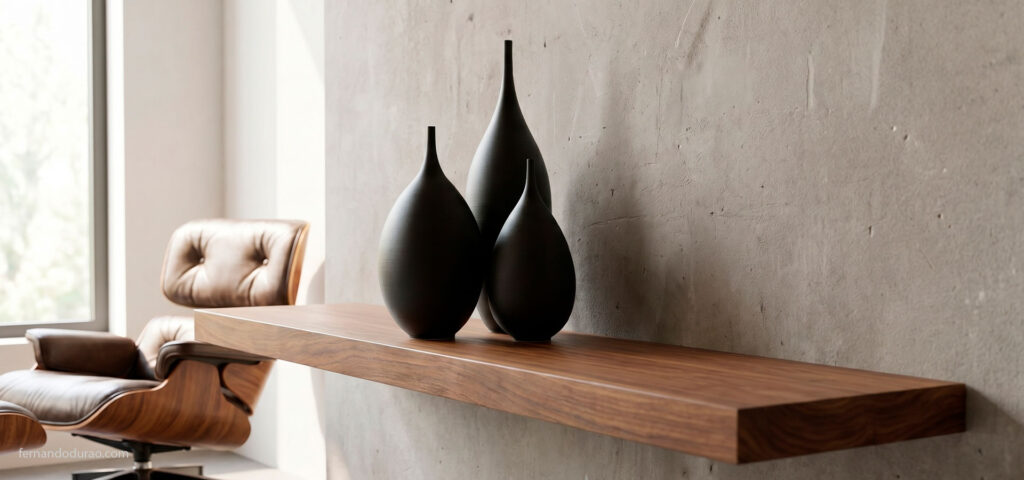
Stoneware is a type of high-temperature ceramic. For a clay to become stoneware, it needs to be fired in a range between 1170°C (2138°F) and 1250°C (2282°F). That is not a minor technical detail: it is what determines everything that piece will be.
At those temperatures something happens that happens in no other ceramic firing: the clay vitrifies. The particles of the clay body fuse at the molecular level. The transformation is internal, structural, irreversible.
The result is a piece with a specific weight, a density and a strength that you perceive before knowing anything about ceramics. When you lift a stoneware vase, you notice. It has presence. It has mass. It has the solidity of something that won't break at the first knock or deteriorate over time.
What happens in common mass-produced ceramics
Common industrially produced ceramics are fired at significantly lower temperatures: around 1020°C (1868°F). At that temperature, the clay does not vitrify. It keeps its porosity. It needs glaze to be sealed, and that glaze is, in most cases, commercial: formulated to be stable, predictable and reproducible across thousands of identical units.
The production process starts from molds. A form is repeated identically in hundreds or thousands of pieces. The glaze is applied uniformly. The result goes into the kiln and comes out the same as the one before and the one after.
There is no process. There is no decision. There is no ceramicist.
What exists is industrial efficiency. And that has its place in the world, but it is not the same as a design object with an identity of its own.
The potter's wheel: where the real difference begins in handmade stoneware ceramics


In Fernando Durao's case, the distinction goes even further in handmade stoneware ceramics.
Every piece in the Black, Quartz and Moradores collections is born on the potter's wheel, entirely by hand. There is no mold. There is no predefined form that is repeated. There is a stoneware clay body, a spinning wheel and 35 years of craft that decide in real time what that piece will be.
The form emerges from the dialogue between the hand and the material. The walls open or close millimeter by millimeter. The height, the diameter, the thickness of the base, the tension of the curve — everything is decided in that moment, on that wheel, with that clay.
That is why no two pieces are alike. Not because irregularity is sought as an aesthetic, but because the handmade process makes perfect sameness impossible. And that impossibility is, exactly, the value.
Oxides and fluxes in the workshop: the ceramicist's signature
The high temperature of stoneware opens a possibility that low-fire ceramics don't have: experimenting with metal oxides and fluxes to create glazes of one's own, unique, not available in any commercial catalog.
Oxides — iron, cobalt, manganese, copper, among others — react differently depending on the temperature, the kiln atmosphere and the composition of the clay body. At 1200°C (2192°F) those reactions are complex, unpredictable in the detail and extraordinarily rich in result.
Fernando Durao develops his own glaze formulas from that experimentation. The deep black of the Black collection is not a catalog black glaze. It is the result of years of testing with specific oxides and fluxes, firings at different temperatures, adjustments in the composition that gradually defined a color, a texture and a finish that are recognizable as his own.
The same goes for the mineral texture of Quartz or the finishes of Moradores. Each collection has a glaze identity that can't be bought anywhere because it exists nowhere else. Fernando formulated it, Fernando tested it and Fernando fires it.
That is what studio ceramics means.
Why this matters when decorating
When you choose a decorative vase or a sculpture for a space you care about, you are also choosing everything that object communicates.
A mass-produced object communicates that the criterion was price. A design object in high-fired stoneware, made on the potter's wheel with its own glazes, communicates something completely different: that there was a decision for quality, that the unrepeatable was chosen over the convenient, that this space deserves what it holds.
High-level architects and decorators know this. That is why they choose studio ceramics when the project deserves it. It isn't snobbery: it's judgment.
Stoneware pieces. Made on the wheel. With their own glazes.
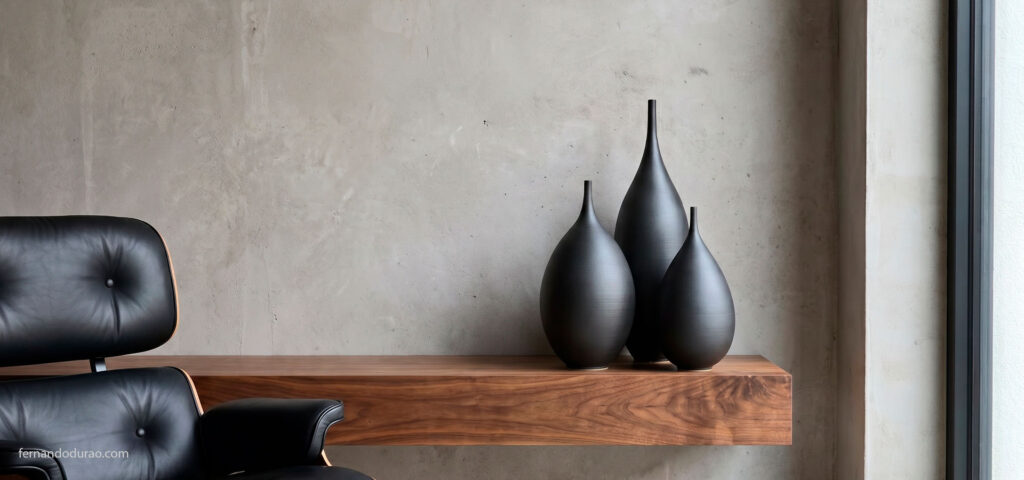
Fernando Durao's collections are exactly that. Each piece comes off the potter's wheel in his workshop in Lanús, Buenos Aires. Each glaze is a formula of his own. Each firing at 1200°C (2192°F) produces results that never repeat exactly the same way.
One-of-a-kind, signed pieces. Shipping throughout the country.
→ View collections: https://fernandodurao.com/tienda/