
How to decorate with tall vases: a guide for minimalist spaces
I've been in my workshop for 35 years and I keep reaching the same conclusion: a well-placed tall vase does more for a space than any other decorative decision. Not because it's flashy. Because it is quiet in the right way.
This guide is what I tell any architect or decorator who consults me about how to integrate large-format pieces into an interior. Concrete ideas, no beating around the bush.
Why a tall vase is not decoration — it is architecture
A tall vase in handmade stoneware ceramics introduces something most elements in an interior don't have: a verticality of its own. It doesn't depend on the wall, doesn't need to hang from anything, doesn't require support. It rests on the floor and organizes the space around it.
In a living room with a standard ceiling, a piece of 50 or 60 cm (20 or 24 in) defines the vertical scale of the room. In a double-height space, you need more — 70 or 80 cm (28 or 31 in) — so the piece doesn't get lost. The proportion between the vase and the space is the first decision, and the most important one.
A modern studio ceramic vase in the right place doesn't decorate. It anchors.
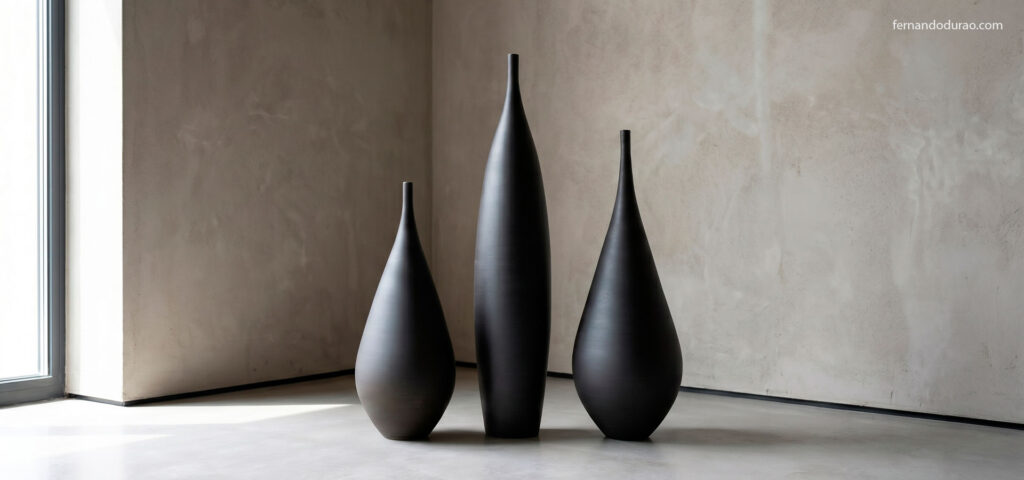
Where to place tall vases: five concrete situations
On the floor, in the corner of the living room
The empty corner of the living room is the most underused place in most interiors. A tall stoneware vase resting directly on the floor, with no pedestal or support, turns that dead space into a point of attention. The key is to leave it alone — no plants, no other objects nearby — so the piece has all the space it needs to breathe.
Next to the window, working with the light
Raking natural light reveals everything stoneware has: the texture of the glaze, the variations in tone, the brush marks. A tall vase placed near a large window changes its look during the day — in the morning it reads one way, at noon another, in the afternoon another. That variation is what makes a piece of handmade stoneware ceramics dynamic within a static space.
In the foyer, as a first impression
The foyer is the prelude to everything that follows. A tall decorative vase in the foyer sets the aesthetic tone of the house before the visitor sees anything else. It doesn't have to be the biggest piece you own — it has to be the best chosen.
As the finishing touch to a sideboard or console
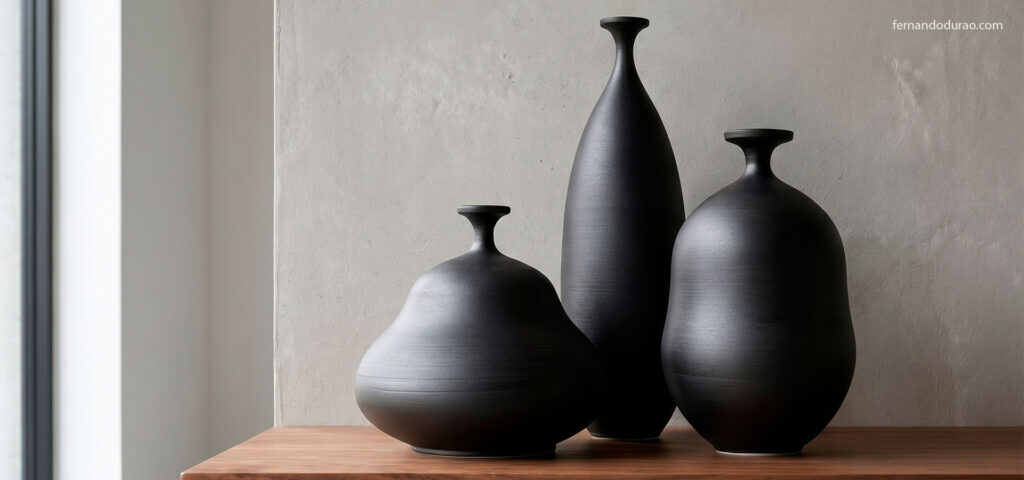
A tall vase on a console or sideboard creates a vertical composition that balances the horizontal furniture. The proportion works when the vase represents between a third and half of the total height of the composition. Nothing on top, nothing beside — just the vase and the surface.
Alone, on a clear wall
A wall with no paintings, no shelves, nothing. And on the floor, leaning against it, a tall vase in studio ceramics. It is the most minimalist gesture and the most powerful. It requires aesthetic confidence — and it works exactly when that confidence is well founded.
Material matters: why stoneware and not another ceramic
Not all tall vases work the same. A mass-produced ceramic vase in a tall space looks small even if it measures 60 cm (24 in) — because it lacks visual density. Stoneware fired at 1200°C (2192°F) has a mass and a presence you perceive without knowing anything about ceramics. It occupies space differently.
The glaze texture also works differently at a large scale. On a small piece, surface detail is seen up close. On a tall piece, that detail reads from a distance as character — as something that clearly didn't come out of a mold.
Artificial light: how to enhance a tall vase at night
Well-thought-out artificial lighting can turn a tall vase into the absolute protagonist of the space. A directional spotlight from above — track or recessed — creates shadows in the glaze texture that don't exist under diffuse light. The piece becomes sculptural in a way natural light doesn't achieve.
For black vases from the Black collection, warm light accentuates the depth of the satin glaze. For white vases from the Quartz collection, cool light enhances the purity of the white and the mineral texture of the surface.
A single piece or a composition
In minimalist spaces the rule is clear: a single tall piece has more impact than three medium ones. A composition of multiple vases works better horizontally — on a shelf or coffee table — than vertically. When you stack heights on the floor, the group competes with the architecture instead of complementing it.
If you want to use more than one piece on the floor, the distance between them has to be generous. Let each piece have its own breathing room. It shouldn't look like they were grouped for lack of judgment but by decision.
See available pieces
The Black, Quartz and Moradores collections include large-format pieces thrown on the wheel in the Lanús workshop, Buenos Aires. Each vase is one of a kind and signed. Free shipping throughout Argentina.