
Is it worth investing in studio ceramics? What nobody tells you about decorative art

Investing in studio ceramics is a question many people ask themselves in silence. They see the piece, they like it, but something holds them back. The price seems high compared with what they find in any decor shop. And yet, something about the piece keeps speaking to them.
This article is not a sales pitch. It is an honest attempt to explain what sets a piece of studio ceramics apart from everything else, and why that difference has the value it has.
The wrong comparison
The most frequent mistake is to compare a piece of studio ceramics with a decorative vase from a shop. It isn't the right comparison.
It is like comparing a table handmade by a cabinetmaker with thirty years of craft with a mass-produced table. Both have four legs and a surface. But they are not the same object, they don't have the same process behind them and they won't age the same way.
A piece of handmade stoneware ceramics made on the potter's wheel, with its own glazes developed over years of experimentation and fired at 1200°C (2192°F), doesn't compete in the same market as a modern vase mass-produced with commercial glazes and molds. They are different categories.
The right question is not “why does it cost so much?” but “what exactly am I buying?”
What you buy when you buy studio ceramics
A process that cannot be rushed
A piece of studio ceramics is the result of a process with no shortcuts. The stoneware clay is centered on the wheel by hand. The walls open millimeter by millimeter. The form is decided in real time, in dialogue between the hand and the material.

Then comes the glaze: a formula of my own, developed with metal oxides and specific fluxes, applied with a brush. And then the kiln, at 1200°C (2192°F), where vitrification happens and where the glazes react in ways that are never completely predictable.
All of that takes time. It takes craft. It takes years of error and correction to reach a result worth signing.
That is what you buy. Not an object. A process made object.
A piece that exists nowhere else
Every decorative stoneware vase made on the wheel is unique. Not because difference is sought as an aesthetic, but because the handmade process makes exact repetition impossible. The form, the glaze, the variations of the firing — everything converges in a result that happened only once and will not happen exactly the same way again.
That has a name: unrepeatability. And it is the opposite of what mass production offers, where the value lies precisely in all the pieces being the same.
When you place a piece of studio ceramics in your living room or in an interior design project, you are placing something that exists nowhere else in the world. That is not a marketing argument. It is a direct consequence of the process.
An object that improves with time
Mass-produced ceramics age. Commercial glaze can lose vibrancy. The pieces look more and more like what they are: disposable objects with an aesthetic expiration date.
High-temperature vitrified stoneware does not age that way. It is dense, structurally stable. It doesn't deteriorate. It doesn't fade. The patina it develops over the years — use, light, time — makes it more interesting, not less.
A piece of handmade stoneware ceramics well chosen is an object for life. And that completely changes the calculation of value.
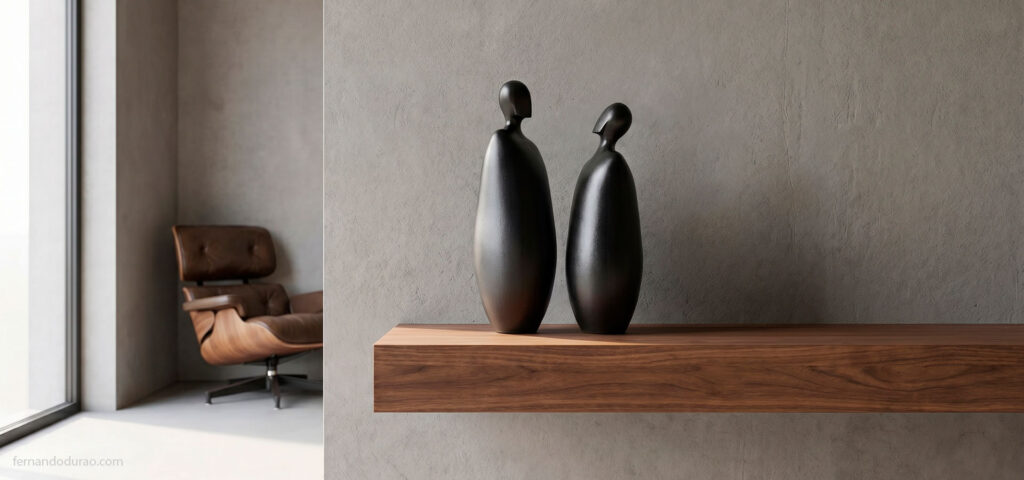
What a piece of studio ceramics communicates
There is a dimension of value that is hard to quantify but that any experienced architect or decorator recognizes immediately: what an object communicates about the space and about whoever inhabits it.
A mass-produced design object communicates that someone decorated. A piece of studio ceramics communicates that someone chose. That there was judgment, there was research, that it was decided this space deserved something special.
Craft as part of the value
Fernando Durao has spent 35 years working with stoneware. Thirty-five years of the wheel, of kilns, of glaze formulas adjusted firing after firing until reaching a result with an identity of its own.
That craft is not a biographical detail. It is a constituent part of every piece. The hand that centers the clay on the wheel knows exactly how much pressure to apply and when. The eye that assesses the glaze before the firing knows how to read what will happen inside the kiln. The judgment that decides whether a piece is worth keeping or goes to the discard pile is the result of decades of work.
When you buy a piece of studio ceramics, that craft comes inside. You can't see it, but you feel it. In the weight, in the form, in the way the piece occupies the space.
Is it worth it? The honest answer
It depends on what you are looking for.
If you are looking for a decorative object to fill a space without giving it much importance, studio ceramics is probably not what you need. There are more affordable options that serve that function.
But if you are looking for a piece with real presence, that improves with time, that is unrepeatable, that communicates judgment and that can live in your space or in an interior design project for decades without going out of date — then the question is not whether it is worth it. The question is which one.
The Black, Quartz y Moradores by Fernando Durao are exactly that. One-of-a-kind stoneware pieces, made on the potter's wheel, with their own glazes applied with a brush and fired at 1200°C (2192°F). Signed by the ceramicist. Shipping throughout the country. Free throughout Argentina.
Frequently asked questions about studio ceramics as an investment
Does studio ceramics appreciate in value over time? Pieces by ceramicists with a track record and recognition tend to hold or increase their value over time, especially when signed. But beyond financial appreciation, their main value is that they don't deteriorate or lose their aesthetic relevance.
How do I know a piece is really artist-made and not mass-produced? By the ceramicist's signature and the physical characteristics: weight, glaze variations, irregularities typical of the handmade process. A mass-produced piece is identical to the next one. An artist-made piece never is.

Does handmade stoneware ceramics require special care? No. Stoneware vitrifies the clay body and is very strong. It requires no special treatments or care beyond cleaning with a damp cloth.
Can I ask for a specific piece? I don't make pieces on commission. In the shop you will find many options. For questions about availability, you can contact Fernando Durao's workshop directly.
Fernando Durao. Handmade ceramicist. 35 years of craft. Workshop in Lanús, Buenos Aires. Free shipping throughout Argentina.