
Decorative vases: a guide to choosing pieces that transform a room
A room changes completely when the right piece appears. There is no need to renovate anything: a well-chosen vase on a console is enough for the space to gain character, silence and an intention it didn't have before. decorative vases are, perhaps, the most effective object for achieving that, because they concentrate a lot of presence into very little space.
But choosing well is not as simple as it seems. Form, scale, finish and placement work together, and when one of them fails, the piece becomes invisible or, worse, clashes. This guide is meant to help you make that decision with discernment: not from passing fashion, but from what really makes an object hold the eye for years.
Why a vase decides the character of a room
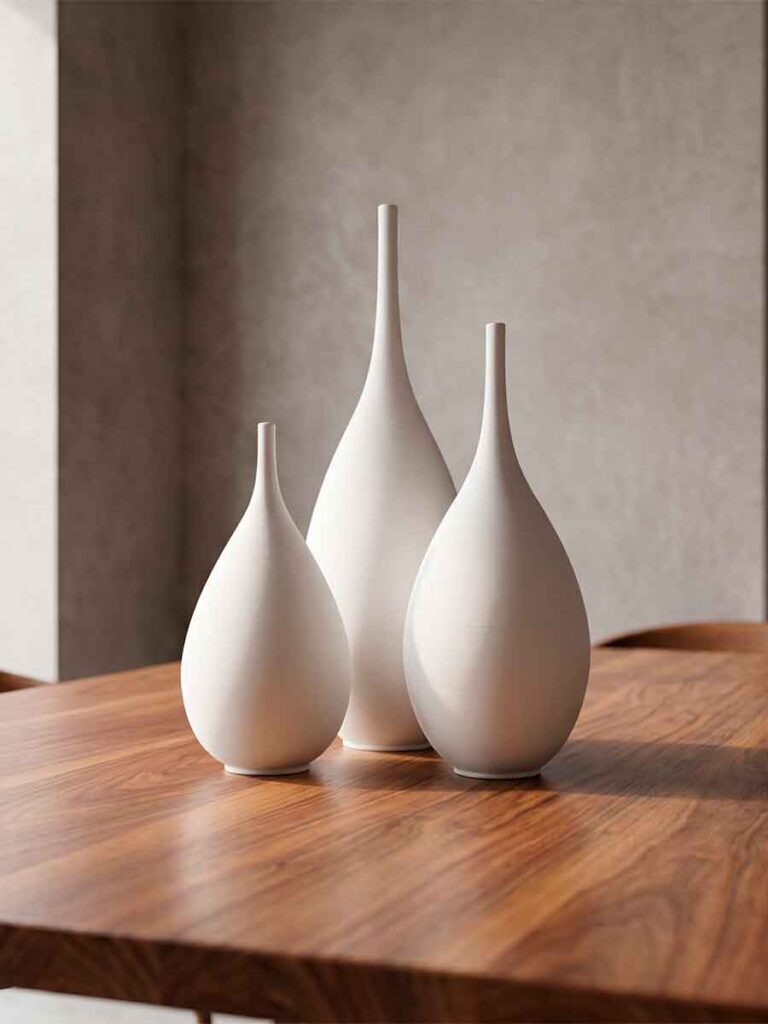
There are objects that take up space and objects that organize the space around them. A good vase belongs to the second group. Its vertical silhouette breaks the horizontality of a table or shelf, creates a focal point and makes the eye stop. In a minimalist decor, where every element has to justify its presence, that ability to concentrate attention is worth its weight in gold.
The key is to understand that a decorative vase doesn't accompany: it proposes. When you choose a piece with a defined shape and careful proportion, you are not filling a void, you are stating a taste. That is why it is better to think of them less as ornaments and more as design object that converse with the architecture, the furniture and the light of the place where they will live.
What distinguishes an artist-made decorative vase
Here is the difference that is almost never explained. An industrial vase is made in a mold, by the thousands, identical to itself. A piece of studio ceramics is born from a decision: someone thought up that form, raised it with their hands on the wheel and decided every curve, every thickness, every finish.
All my pieces are handmade, one by one, in stoneware fired at 1200°C (2192°F). That temperature is not a minor detail: it turns the clay into a vitrified, dense and strong material, very far from common low-fire ceramics. The handmade stoneware ceramics has a weight, a resonance and a nobility you feel as soon as you touch it. No two are exactly alike, and that is precisely the idea.
When I talk about handmade work I don't mean the “rustic” look that became fashionable. For me, handmade means exactly the opposite: rigor, pure form, precise line. The mark of the hand is in the quality of the result, not in imperfection as an excuse.

Form: pure lines and proportion
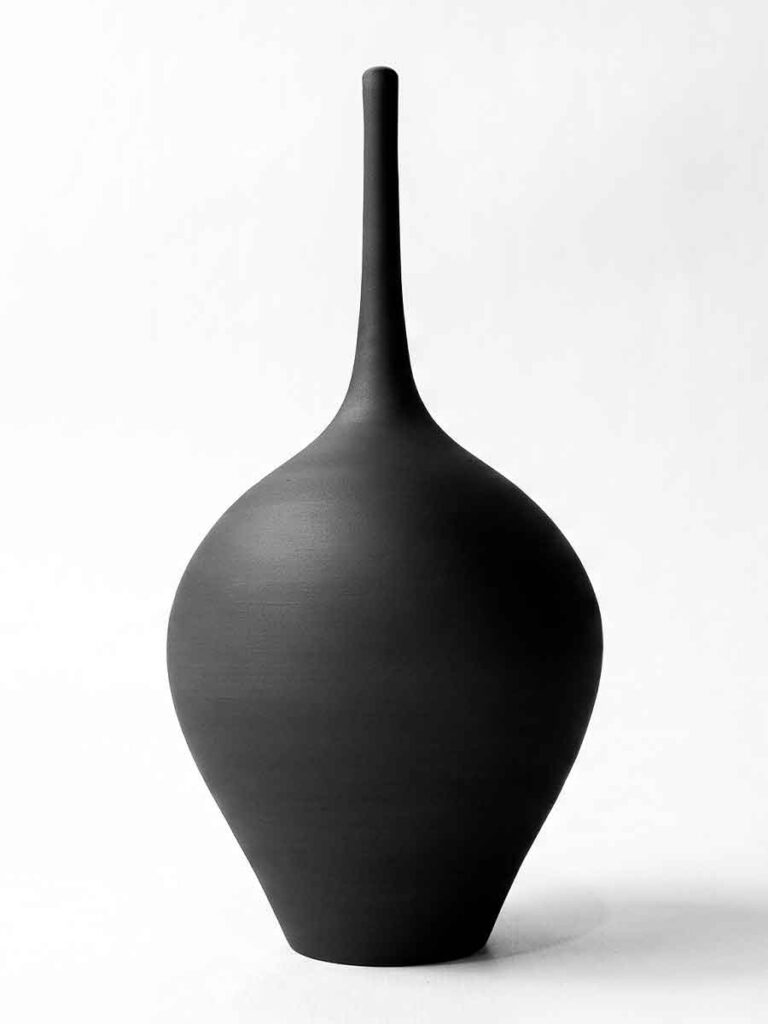
Form is the first thing you read, even from afar. A long-necked vase with a full body conveys elegance and tension; one with a wide base and a short mouth conveys calm and weight. Neither is better: it depends on what you want the room to say.
My recommendation is to prioritize the clean line. Silhouettes that stand on their own without decoration — the ones that trust the pure relationship between curve and proportion — are the ones that never tire. A well-resolved form is still interesting in the fifth year; a form loaded with tricks bores you by the sixth month. If you lean toward the contemporary, the modern vases with a refined line are the safest bet.
Scale: how to choose the size for the space
This is the most common mistake: choosing a piece too small for the place. A small vase lost on a large console looks timid, almost forgotten. The practical rule I use with architects and decorators is simple: the piece (or the group) should take up between a third and half of the visible width of the surface where it goes.
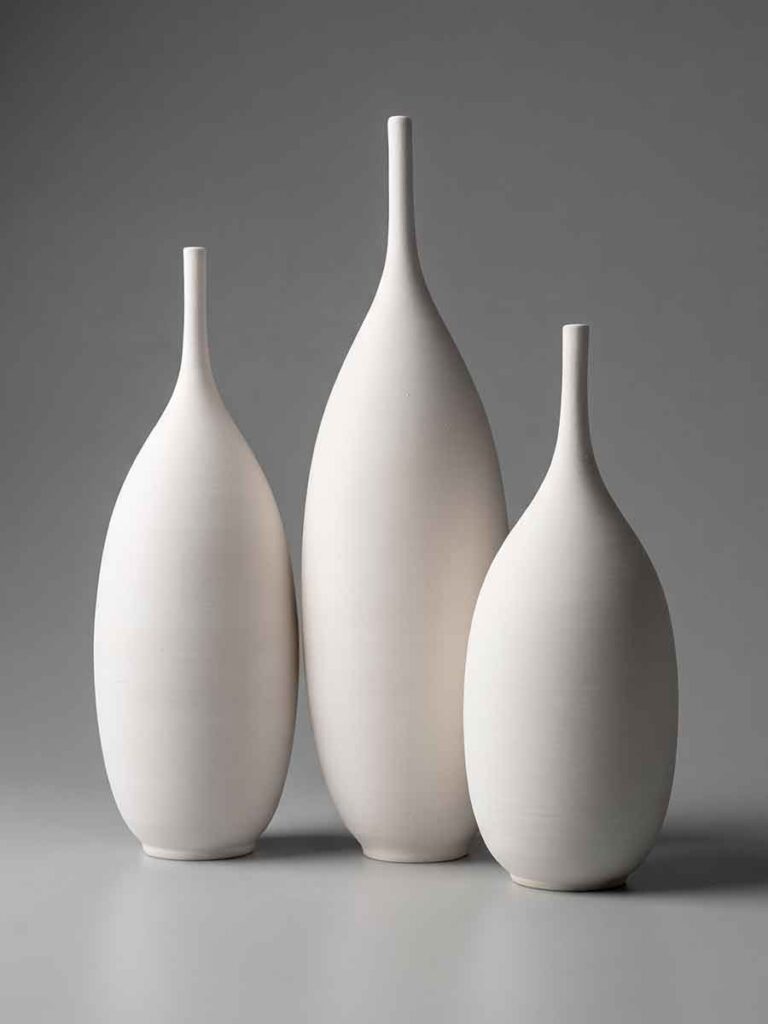
Another strategy that almost never fails is grouping by height. Three pieces of different sizes together create a much richer visual rhythm than a single isolated piece. The eye travels from one to the next and the group reads as a small composition. If you hesitate between one large piece or a trio, the trio almost always wins in presence.
Finish: matte, satin and gloss
Finish is what photography doesn't always manage to show, but it is what most defines the experience of having the piece nearby. I work in three registers — matte, satin and gloss — and I often combine them in a single piece, applying the texture with a brush so that light behaves differently in each area.
A matte finish absorbs light and conveys serenity, ideal for rooms of minimalist decor where calm is sought. A satin finish adds an intermediate subtlety, a contained gloss that reveals itself when you get closer. And full gloss, used with judgment, adds a point of energy. The richness is in the mix: it is what gives the piece a life of its own depending on the time of day and the light it receives.
Where to place them: console, niche, table or large room
The same piece can shine or go unnoticed depending on where you put it. Some placements that always work:
- On an entryway console: the first object to greet whoever arrives. A tall piece with a strong line is ideal.
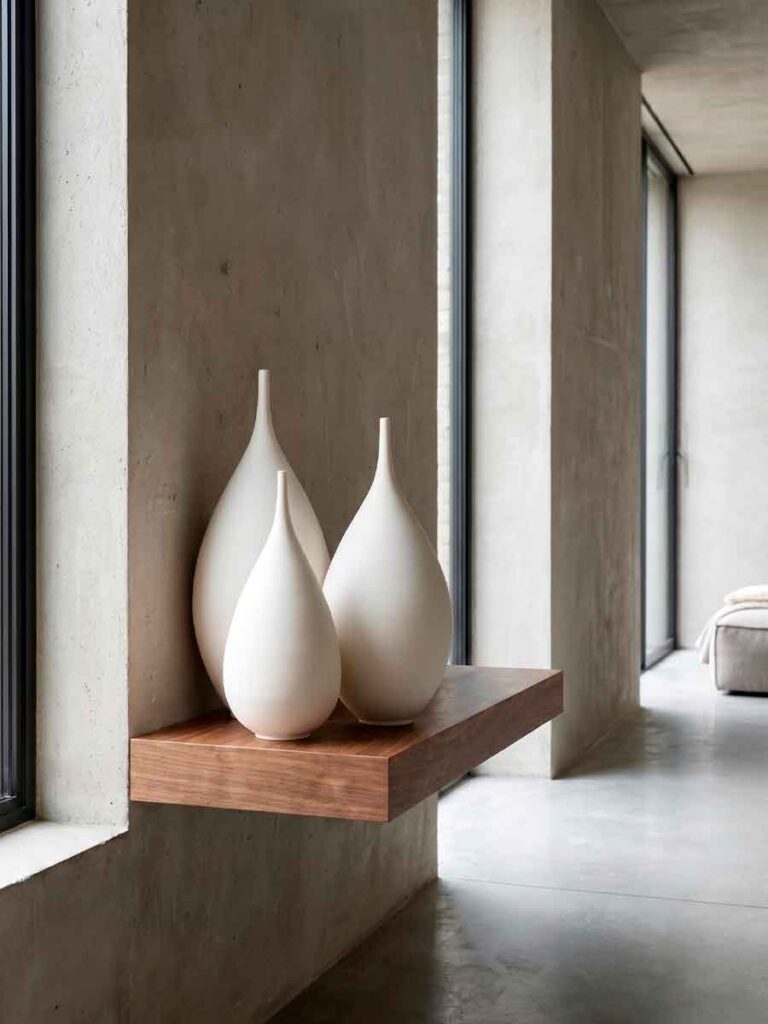
- In a niche or floating shelf: the architectural frame enhances the silhouette. Here grouping by height looks especially good.
- At the center of a dining or side table: a sculptural piece replaces the typical centerpiece with far more personality.
- In a large, uncluttered room: a large piece, on its own, holds an entire corner without needing anything else.
Thinking about placement in advance is part of good interior decor: it is not about “putting a vase”, but about giving the piece the place where its form can breathe.
White or black: how to choose the palette
It is the question I'm asked most. There is no single answer, but there is a clear logic.
The White —my collection Quartz, with a mineral finish— brings light, visually expands the space and lives with almost everything. It is the safest choice for light rooms, warm woods and neutral palettes. If you are after serenity and continuity, white almost never fails.
Black — my Black collection— does exactly the opposite: it creates contrast, anchors the room and conveys sophistication. A black piece on a light surface is a statement. It works wonderfully in contemporary spaces, with concrete, glass or metal.
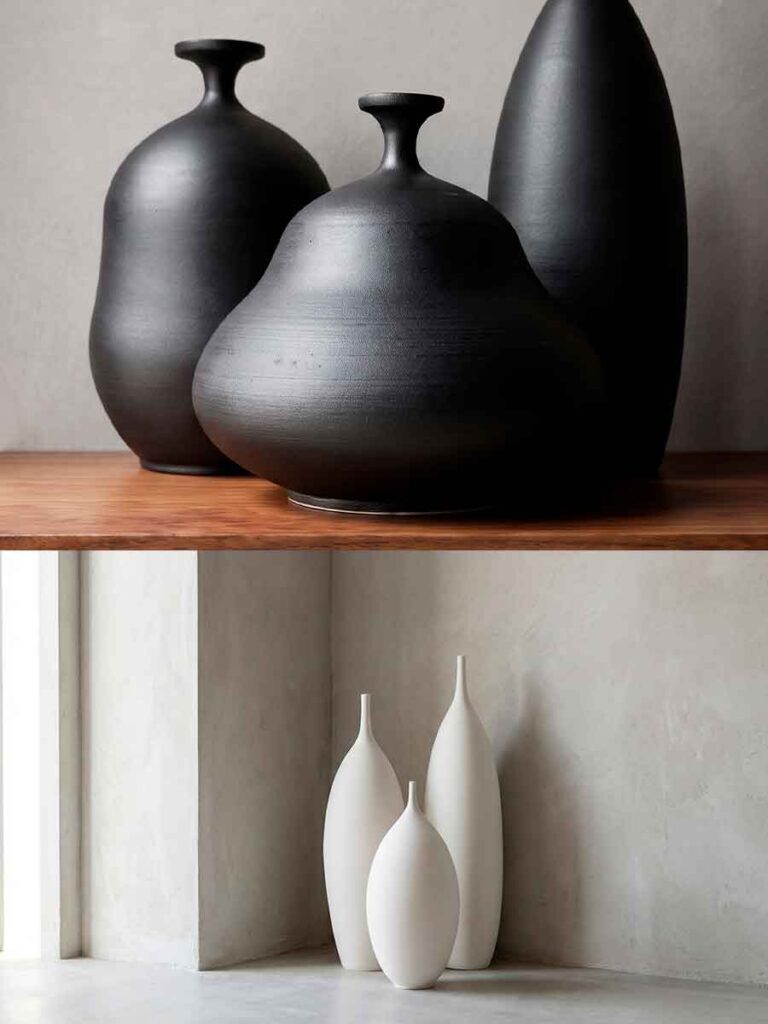
If you lean toward light, I invite you to see the Quartz collection of white decorative vases. And if contrast and character are your thing, take a look at the modern vases from the Black collection.
Buy directly from the artist: one-of-a-kind signed pieces
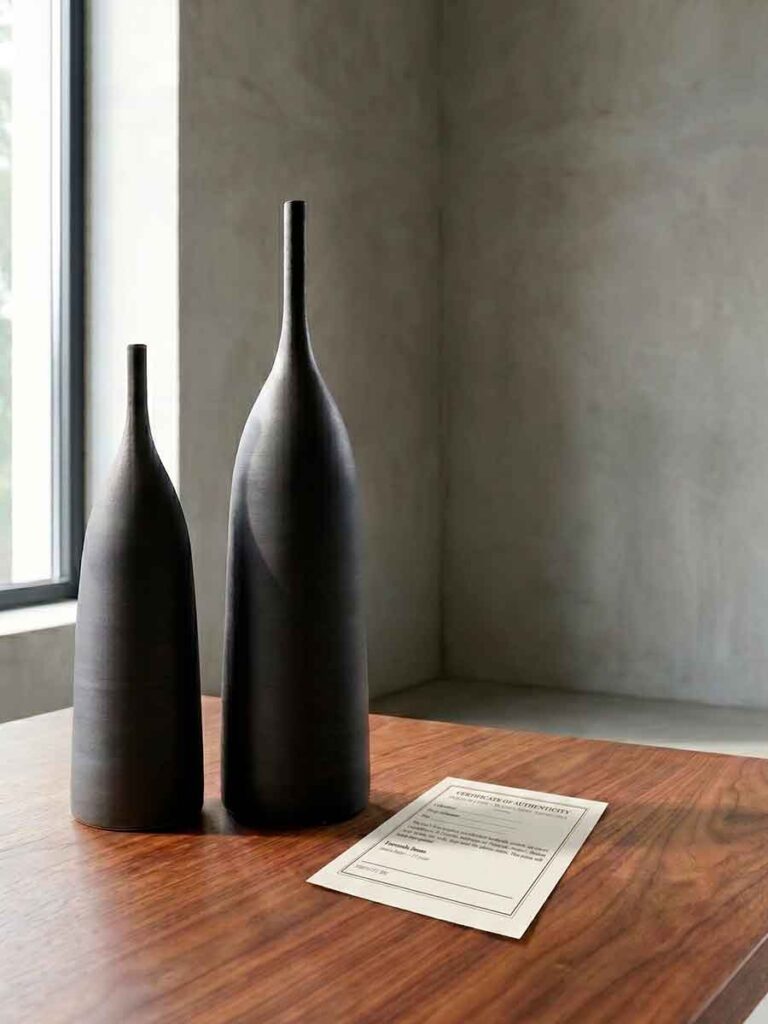
When you buy a piece directly from the person who made it, you are not acquiring a catalog product: you are taking home a unique object, with its story and its authorship. Each of my pieces is signed by me, a guarantee that goes with the work and that, over time, is part of its value.
It is the same logic by which architecture studios, hotels and design leaders choose studio pieces for their projects. My work is part of spaces curated by figures such as Laura O. y Casa Chic, is exhibited at Fontenla and took part in Casa FOA hand in hand with Hugo Di Marco. It is no coincidence: whoever understands design looks for the piece no one else will have.
Buying directly from the artist also means a different relationship. You can ask questions, commission, coordinate delivery. Behind every piece there is a person and a craft of more than 35 years, not a production chain.
In short
Choosing a decorative vase well is a matter of looking at four things together: the form (one that holds the eye with pure lines), the scale (one that takes its place without timidity), the finish (matte, satin or gloss depending on the room) and the placement (where the piece can breathe). When those four decisions line up, the result is not just another ornament: it is an object that gives the space character for years.
If you are looking for a piece like that —studio ceramics handmade, in stoneware, made to last— I invite you to explore my collections. Free shipping throughout Argentina. Every piece is one of a kind, and you are probably already imagining where yours will go.