
How to decorate a minimalist living room with works of art
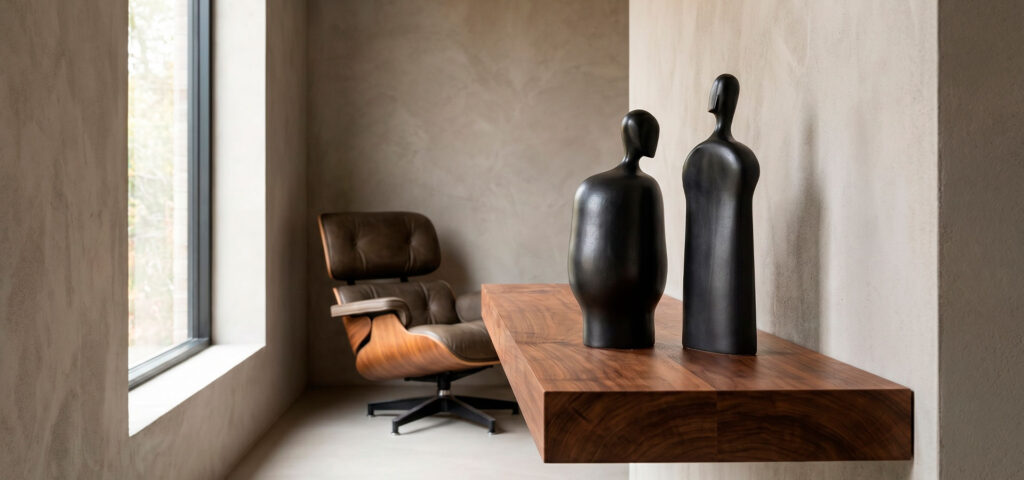
Decorating a minimalist living room with works of art is not a contradiction — it is a decision of precision. Minimalism doesn't mean empty: it means that every object you choose has to justify its presence. And that demands much more of the object than in any other style.
In 35 years of working with handmade stoneware ceramics, I learned that a well-resolved minimalist space doesn't need many objects. It needs one good one.
What makes an object work in a minimalist living room
The short answer: character of its own. A mass-produced object in a minimalist living room shows — you can tell it has no history, that it could be anywhere, that it wasn't chosen but bought.
A studio ceramic decorative vase works differently. It has visual weight, real texture, a form that doesn't repeat. When you place it in the right spot, the whole living room organizes itself around it without anyone being able to explain exactly why.
That is what a well-chosen design object does: it doesn't decorate the space, it defines it.
Where to place pieces in a minimalist living room
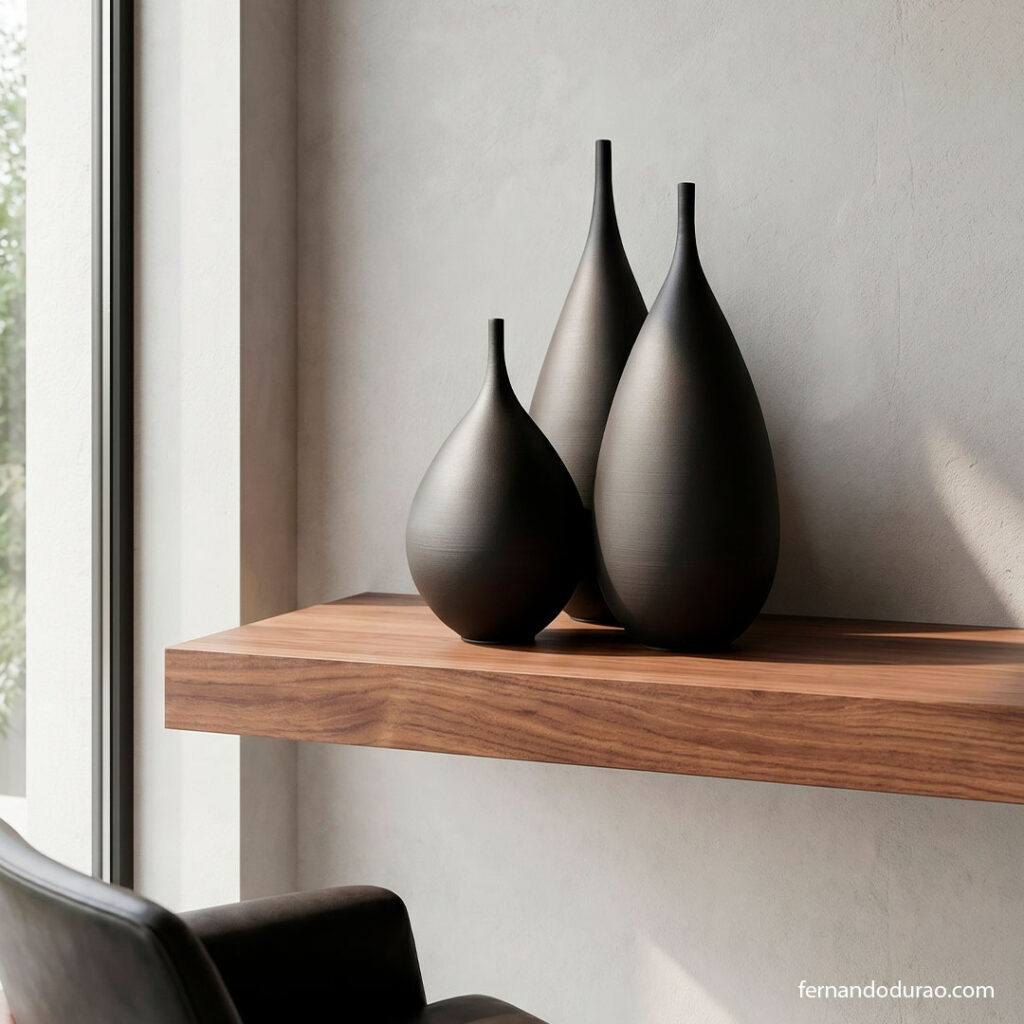
On a floating shelf or ledge. It is the most effective place for medium-height decorative vases — between 20 and 40 cm (8 and 16 in). The natural wood beneath black or white stoneware creates a contrast of materials that needs nothing else around it.
In the corner of the living room. An unresolved corner is the ideal place for a tall handmade ceramic vase — 45 or 50 cm (18 or 20 in) high, alone, with no support from other objects. It turns a dead space into a point of attention.
On the coffee table or sideboard. A single piece, centered or slightly off to one side. Not in a group — in a minimalist living room, a single piece has more force than three together.
How many pieces to use
Fewer than you think. In a minimalist living room, two or three well-chosen objects are enough to define the space. The most common mistake is adding pieces to “complete” a room that was actually already complete.
If you use vases in a group — on a shelf, for example — an odd number works better visually. Three pieces of different heights create a more dynamic composition than two of the same size. But even then, the group has to breathe: space between the pieces, not stacked.
What materials work best
At minimalist decor, natural materials are the ones that age best. Stoneware fired at 1200°C (2192°F) has a tactile presence that industrial materials can't replicate — a texture that changes with the light, a weight you feel in the hand, a characteristic resonance to the touch.
Glazes of my own — matte, satin, quartz — respond differently depending on the time of day and the direction of the light. That is what gives life to an object in an uncluttered space: that it isn't always the same.
Studio ceramics vs. generic decor
The difference is not just aesthetic — it is conceptual. A piece of studio ceramics is unrepeatable: once sold, that combination of form and glaze never exists again. That makes it part of the identity of a home, not a replaceable accessory.
Clients who choose my pieces for their living rooms keep them when they move. They place them in the center of the new space before the furniture. That doesn't happen with mass-produced objects.
See available collections
If you are looking for a piece for your minimalist living room, you can see the available stock in the shop. Each work is one of a kind and never restocked — when it sells, it isn't replaced.