
nobility, high temperature and artist-made objects
When we choose a decorative piece to live in our spaces, the nature of the material and the intention of the artist define everything. If you wonder what stoneware ceramic is, the answer is not simply fired clay; it is the result of a physical-chemical process in which earth and extreme fire at 1200°C (2192°F) combine to create objects with an unchanging presence, noble texture and a sober minimalist aesthetic.
How can you tell stoneware ceramic at a glance?
If you wonder how to tell whether a piece is stoneware ceramic at a glance, there are three unmistakable traits that give it away before you see a label. First, its particular color and the unique texture that the minerals fused at high temperature give it, offering a warm, dense and deeply organic feel without the need for heavy commercial glazes. Second, its weight and solidity when you hold it. Finally, an infallible test is the sound: when you tap it gently with a knuckle, the piece gives off a high, clear, resonant tone (similar to a wine glass), unlike the dull, muffled sound produced by common low-fire ceramics because of their porosity.
The chemistry of vitrification: how clay is transformed at 1200°C (2192°F)
To understand in depth what stoneware ceramic is, it is necessary to look at the process of vitrification, a key chemical transformation that happens during high-temperature firing:
- Molecular transformation: On reaching 1200°C (2192°F), the minerals present in the stoneware clay body (such as silica, feldspars and quartz) begin to melt. This partial fusion, or “glassy phase”, fills the microscopic pores left between the clay grains.
- Compaction of the ceramic body: As the temperature is held, the material contracts evenly. The liquid glass resulting from the melting of the minerals seals the internal structure, turning the permeable clay body into a dense, solid mass of great durability.
- Minimal residual porosity: While common ceramics or earthenware have an average porosity of 5% (which makes them permeable and mechanically fragile), stoneware reaches a residual porosity of only 0,1% a 0,5%, giving it exceptional mechanical resistance against the passage of time.


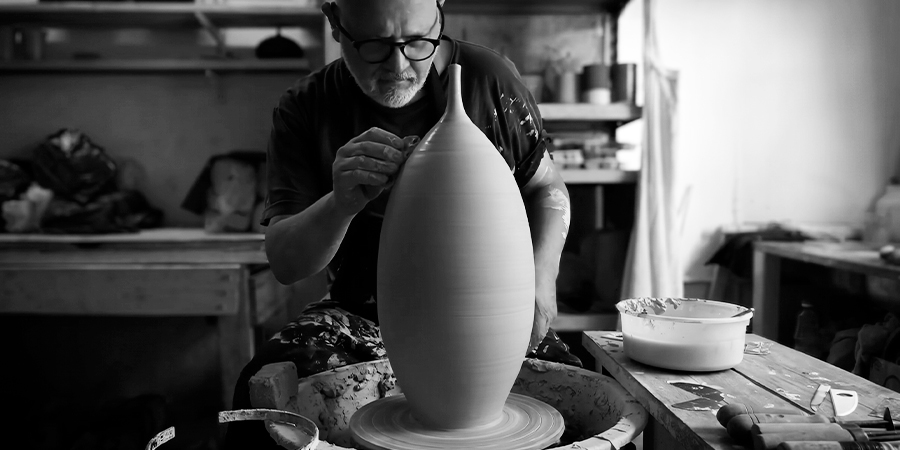
Images of my ceramic process and my locally made kiln, of excellent quality for stoneware.
Comparison chart: common ceramics vs. studio stoneware
| Characteristic | Common Ceramics / Earthenware | Studio Stoneware |
|---|---|---|
| Firing temperature | 800 °C a 1080 °C | 1200°C (2192°F) (High temperature) |
| Residual porosity | Approximately 5% (Permeable) | Between 0.1% and 0.5% (Vitrified structure) |
| Purpose of the object | Generally mold-made / mass-produced tableware | Decorative sculptural pieces (Studio work) |
| Strength and durability | Low to moderate, prone to chips and glaze crazing. | Very high, solid body that will not warp |
| Finishes and surface | Usually requires thick commercial glazes | Glazes of my own formulation (satin black and matte white) |
The Art of the Potter's Wheel and the Search for the Sculptural Trio
In the workshop, high-temperature technique is combined with more than 30 years of craft. Each vase is thrown individually on the potter's wheel, where improvisation and continuous play with lines give each piece a unique visual rhythm. No molds and no mass reproductions.
The matte glazes are formulated specially in the workshop from feldspars and mineral oxides, applied with a brush so that they fuse inseparably with the stoneware body during firing:
- Unikas Black: Organic silhouettes in satin black stoneware with a deep, sober finish.
- Unikas Quartz: The purity and serenity of matte white stoneware, made to bring contrast and light.
Although each piece has a character of its own and can stand alone, they are designed to be combined in sets of three vases, creating rhythms of heights, necks and volumes that transform bookcases, coffee tables and entry consoles.
Discover the collections in the online shop
Sculptures and studio compositions: Unlike everyday tableware, my vases are not meant to hold water or wet flower arrangements. They are conceived as sculptural pieces and purely decorative design objects, designed to stand out on their own or to converse in groups of three within the architecture of a room.
Now that you know what stoneware ceramic is and the value of its handmade making, we invite you to explore the catalog of available pieces directly from our workshop:
Benefits of buying direct:
- Free shipping throughout Argentina with high-protection packaging to guarantee delivery in perfect condition.
Visit the online shop for decorative vases to discover the combinations and sets available for your interior design projects.
Would you like advice, or are you ordering from abroad?
If you have doubts about which set to choose for your space, are looking for a custom composition, or want to make a purchase with shipping abroad, write to us through the form below. We arrange international shipments with special maximum-protection packaging so the pieces arrive flawless anywhere in the world. Leave us your inquiry and we will reply shortly.